
 国际站
国际站 
在学术论文的浩瀚海洋中,摘要 (Abstract) 毫无疑问是整篇文章的“门面”。审稿人往往通过阅读摘要来决定是否继续审阅您的稿件;而其他学者在检索文献时,也主要依靠摘要来判断您的研究是否值得下载阅读。
许多初写论文的学者容易将摘要写成繁琐的引言,或者堆砌晦涩的数据。其实,一篇高质量的英文学术摘要(通常在150-250字之间)是有迹可循的。本文为您总结了国际通用的“四句话结构公式”,并提供范例解析,助您快速掌握摘要的写作精髓。
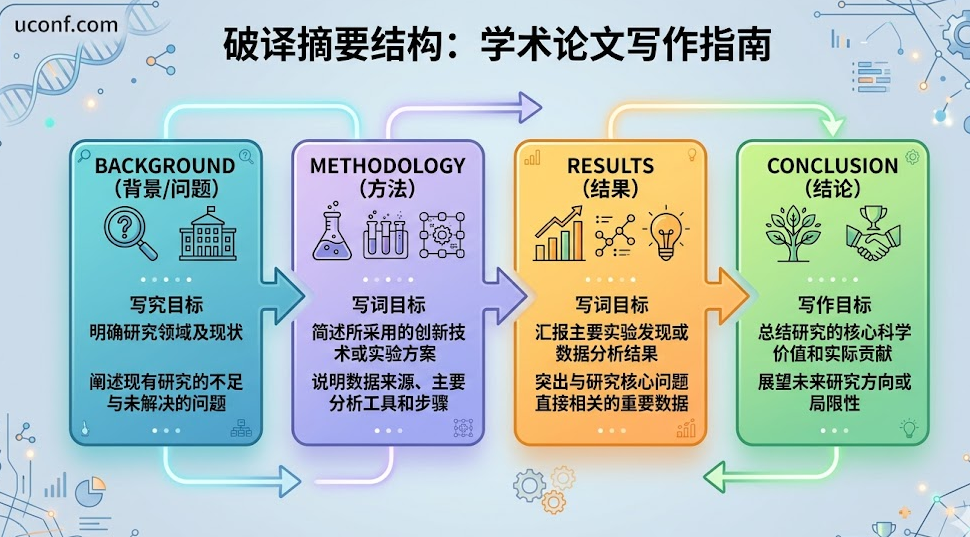
一、 摘要写作的核心:“四句话结构公式”
无论您研究的是量子物理还是古典文学,一篇逻辑严密的摘要通常都可以被拆解为以下四个核心部分(我们称之为“四句话”,但实际写作中可根据篇幅扩展为4-6个长句):
1. 第一句:背景与问题 (Background & Problem Statement)
-
目的: 解释您的研究“为什么重要”。一两句话交代研究的大背景,然后迅速聚焦到目前领域内尚未解决的核心痛点或GAP(知识空白)。
-
常用句型:
-
While [Topic] has been extensively studied, little is known about... (虽然...已被广泛研究,但关于...仍知之甚少。)
-
A major challenge in [Field] is... (...领域的一个主要挑战是...)
-
2. 第二句:研究方法与目的 (Methodology & Objective)
-
目的: 明确说明“您做了什么,以及是怎么做的”。简练地概述您的实验设计、理论模型或研究框架,不要陷入繁琐的细节。
-
常用句型:
-
In this study, we propose/investigate... by utilizing [Method]. (在本研究中,我们利用...方法提出/调查了...)
-
To address this issue, an experimental framework was developed to... (为了解决这个问题,我们开发了一个实验框架来...)
-
3. 第三句:核心结果 (Key Results)
-
目的: 展示您“发现了什么”。这是摘要中最重要的部分,也是含金量最高的部分。必须提供具体的、实质性的数据或核心发现,而不是泛泛而谈。
-
常用句型:
-
Our results demonstrate that [Finding 1], with a significant increase of [Data]... (我们的结果表明...,显著增加了...)
-
Interestingly, we observed that... (有趣的是,我们观察到...)
-
4. 第四句:结论与影响 (Conclusion & Implications)
-
目的: 总结这篇论文的“价值和意义”。说明您的研究结果对该领域有什么贡献,或者在实际应用中有何深远影响。
-
常用句型:
-
These findings suggest that... and provide a novel perspective for... (这些发现表明...并为...提供了新的视角。)
-
Ultimately, our proposed method paves the way for future applications in... (最终,我们提出的方法为未来在...的应用铺平了道路。)
-
二、 各学科领域优秀Abstract范例解析
为了让您更好地理解这套公式,我们来看两个不同领域的精简版范例:
范例一:理工科类 (如计算机科学/工程)
[背景] Deep learning models require massive amounts of labeled data, which is often expensive to acquire in medical imaging. [方法] Here, we propose a novel semi-supervised learning framework (Med-SSL) that utilizes both a small set of labeled data and a vast amount of unannotated X-ray images. [结果] Experiments on the NIH dataset show that Med-SSL outperforms existing fully supervised methods by 15% in accuracy while using only 10% of the labeled data. [结论] This approach significantly reduces annotation costs and accelerates the deployment of AI diagnostics in resource-limited clinical settings.
范例二:人文社科类 (如心理学/社会学)
[背景] While the negative impacts of social media on adolescent mental health are widely recognized, the mediating role of parental communication remains underexplored. [方法] This study surveyed 1,200 high school students and their parents to examine the relationship between screen time, depressive symptoms, and family dialogue patterns. [结果] Structural equation modeling revealed that active parental mediation does not reduce screen time itself, but significantly buffers the association between social media use and depressive symptoms (p < 0.01). [结论] These findings highlight the critical need for family-based interventions that focus on communication quality rather than mere screen-time restrictions.
三、 写好摘要的 3 个“不要”
-
不要使用缩写或首字母拼词(除非极度通用): 摘要应该是自成一体的(Self-contained),读者在没有阅读全文的情况下也应该能完全看懂。
-
不要在摘要中引用参考文献: 除非您的整篇论文就是为了推翻某篇特定的前人文献。
-
不要先写摘要: 这是一个常见误区。摘要应该在论文的正文和结论全部完成之后,最后才进行撰写。 只有这样,您才能最准确地提炼出全文的精髓。
总结: 写好 Abstract 的关键在于“做减法”。紧紧围绕“背景-方法-结果-结论”这四句话结构,用最精准的词汇传达最核心的信息,您的论文摘要就能成功地抓住主编和读者的眼球。