
 国际站
国际站 
2026年6月10日,顶级学术期刊《科学》(Science)在其“Science News”栏目发表了一篇题为《Misconduct sleuth in China swiftly gains acclaim for callingout questionable papers》的新闻报道,报道称科研打假博主“耿同学”为“中国治理科研不端问题过程中一个出人意料的盟友”。文中援引相关研究者观点称:“这可能是中国首次出现基层举报者借助社交媒体获得广泛正面报道,并推动实质调查的案例。
继Science之后,Nature也亲自下场报道并支持这位以揭发主要在Nature及其子刊发表的造假论文而爆火的博主。
6月12日,Nature 杂志官网刊发长文《‘Student Geng’ ignites research-integrity scandal in China after calling out senior academics》,标题直译就是“‘耿同学’点燃中国科研诚信丑闻,点名高级学者”。这篇报道一出,再次引发热议。
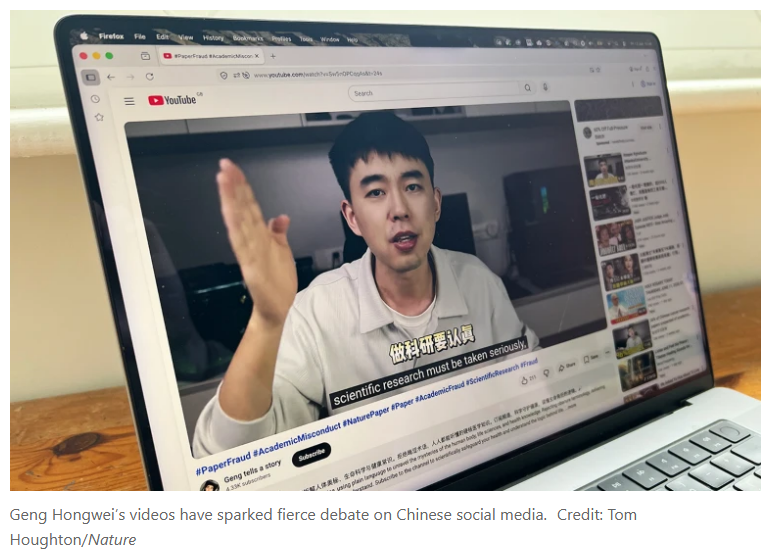
他主要揭发了哪些Nature论文?
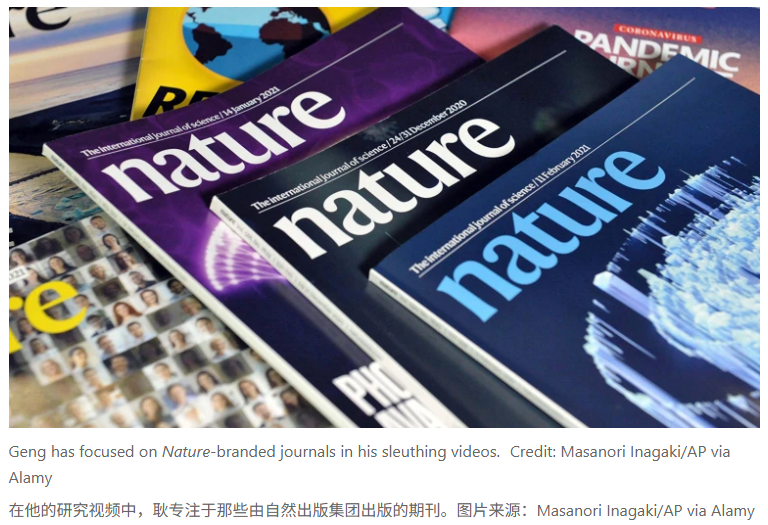
耿同学这次重点“瞄准”了Nature Portfolio期刊(Nature主刊及子刊):
同济大学王P团队(时任生命科学与技术学院院长):2025年1月发表在Nature的论文。耿同学指出原始数据表格中280个数据点里76%以数字5结尾,只有6%以6结尾。他直言:“这些表格是不是在告诉我们,作者特别喜欢数字5?”
南开大学陈Q团队(生命科学学院院长):2024年1月发表在Nature Cancer的论文。耿同学发现补充材料里64组数据的两位小数完全一致(下一张表格对应位置一模一样)。“这两张表说明作者根本不把读者当回事,也蔑视科研的权威。”
此外,他还质疑了Nature Cell Biology 和 Nature Nanotechnology 上的论文,同样指向数据重复、图片异常等问题。
视频爆火后,处理结果来了,而且来得很快:
同济大学(5月6日通报):认定学术不端,王P被免去院长职务、降级两级,第一作者金JL被解除聘用关系。
南开大学(5月30日):陈Q被免去相关职务,第一作者郑H被开除。
中山大学:康TB、邝DM等被处理,认定缺乏严谨性或存在不端行为。
多家高校迅速成立调查组并公布结果,速度之快让国际打假专家Elisabeth Bik都表示“印象深刻”。
Springer Nature(Nature系列期刊母公司)回应称:“我们正在认真调查这些论文,与作者沟通,并酌情咨询独立专家和相关机构。我们非常重视科研诚信问题。”
5月,新华社还发文点赞:“耿同学单枪匹马触发多家机构学术调查,这不仅说明‘高手在民间’,也给国内学术监督体系照了一面镜子。”
Science和Nature为什么都报道他?Science早前已关注这位“ grassroots misconduct sleuth”(草根打假人),称他迅速获得赞誉。而Nature这次的报道更直接:因为他揭发的多篇论文就发表在Nature家族期刊上!这让Nature不得不回应,也让这场讨论更具全球影响力。当然,网上也有不同声音。有人担心“打假风暴”会让普通学生论文审核更严、压力更大;也有人觉得这正是推动中国科研诚信建设的正面力量。
原文报道
全文的报道较为详细,观点表达也颇有意思!(为便于理解,中英对照。翻译略有瑕疵,勿较真):
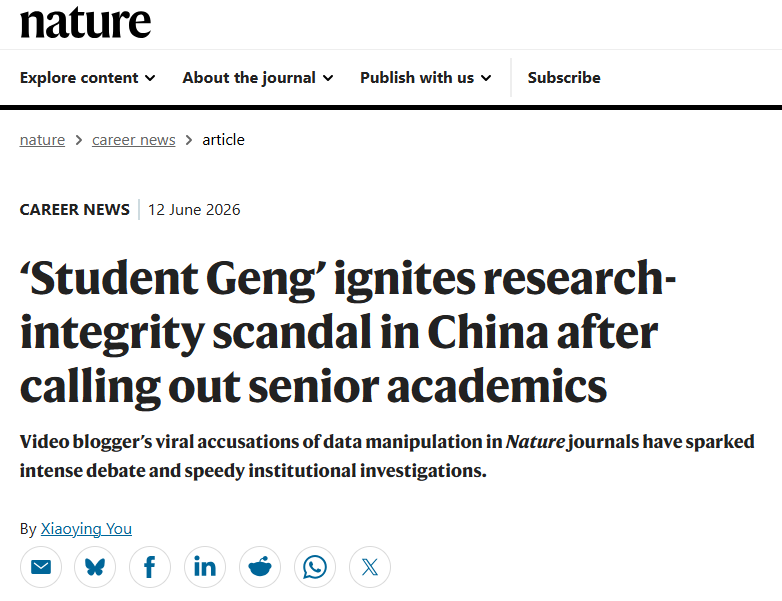
Four senior Chinese academics have been disciplined after a blogger and former PhD student flagged data anomalies in their published papers and went viral in the process.
四位中国高级学者因他们的论文中存在数据异常而被处罚。这些数据异常是由一位博主和前博士生发现的,随后该消息在网上广泛传播。
A blogger known as Student Geng, whose real name is Geng Hongwei, questioned the authenticity of the data in five papers and named five acclaimed researchers at four Chinese universities who co-authored the publications. The papers were published in Nature1 and three Nature-branded journals2–5. One accused researcher is under investigation at his university — the others have faced steep consequences following their institutions’ inquiries.
一位名为“Student Geng”的博主,其真实姓名是耿洪伟,他质疑了五篇论文中数据的真实性。他指认了四位中国大学的五位知名研究人员参与了这些论文的撰写工作。这些论文发表在《自然》杂志上,以及《自然》旗下的三本期刊上。其中一名被指控的研究人员正在接受其所在大学的调查;其余人员则因所属机构展开的调查而面临严重后果。
Data manipulation 数据操作
In a series of videos published on Chinese social media in April and May, each lasting around five minutes and so far collectively watched almost ten million times, Geng explains how he analysed patterns in the data and concluded that the figures might have been fabricated.
在 4 月和 5 月发布的一系列视频中,每篇视频大约持续 5 分钟,这些视频总共被观看了近 1000 万次。耿解释了他如何分析数据中的模式,并得出结论:这些数字可能是被捏造出来的。
For example, he assessed a spreadsheet in the source data of a paper published in Nature in November 2024 that studied how an enzyme in human bodies could regulate DNA damage1. Of the 280 data points in the spreadsheet, 76% ended with the number five, whereas only 6% ended with the number six, the second-most-common final digit. Geng explained that this pattern is extremely statistically unlikely.
例如,他评估了 2024 年 11 月发表在《自然》杂志上的一篇论文中的电子表格数据。该论文研究了人体中的某种酶如何调节 DNA 损伤。在电子表格的 280 个数据点中,有 76%的数据点的结尾数字是“5”,而只有 6%的数据点结尾数字是“6”——“6”是第二常见的结尾数字。耿解释说,这种模式在统计上是非常不可能的。
Geng interpreted this as evidence of data manipulation: “Are you telling me that these figures are authentic?” he asked in one video. After giving more examples of figures ending with five in the same paper, he mocked: “These tables show the authors’ love for the number five.”
耿将这一情况视为数据操纵的证据:“你是想说这些数字是真实的吗?”他在其中一个视频中问道。在举出更多同一篇论文中出现的以“五”结尾的数字例子后,他嘲讽道:“这些表格显示出作者们对数字‘五’的偏爱。”
In April, an editor’s note was posted to the paper, alerting readers to concerns about data reliability and saying an investigation was under way. Editor’s notes were added to the four other papers in May and June.
四月份,该期刊发表了一篇编辑注释,提醒读者注意数据可靠性的问题,并表示正在对此进行调查。五月和六月,其他四篇期刊也增加了编辑注释。
In another spreadsheet, from a paper published in Nature Cancer6 in January 2024 that proposed a way to fight hard-to-treat cancers, the two digits after the decimal point of each of its 64 figures are identical to those of the figures located in the cell in the same position on the next sheet, suggesting that they might have been fabricated, Geng says.
在另一张电子表格中,来自 2024 年 1 月发表在《Nature Cancer》杂志上的论文提出了一种治疗难治性癌症的方法。该论文中列出的 64 个数据中的小数点后的两位数字与同一位置下另一张表格中的数字完全相同。耿表示,这些数字很可能是人为编造的。
“These two tables show that the authors do not care about their readers and despise the authority of scientific research,” Geng jokingly commented.
“这两张表格表明,这些作者根本不关心他们的读者,而且极度蔑视科学研究的权威性,”耿开玩笑地说。
Geng has also alleged in his videos that a further four papers in the Nature portfolio contained irregularities in their data, but he has not named those papers’ authors and their institutions have not announced investigations.
耿还在他的视频中声称,《自然》杂志旗下的四篇论文数据也存在异常现象,但他并未提及这些论文的作者,而这些论文的发表机构也并未宣布对它们进行调查。
After being contacted for comment, Erika Pastrana, vice-president of Nature research and reviews journals at Springer Nature said: “All the papers are being carefully investigated by the SN Research Integrity Group, alongside editorial assessments of the concerns raised, engagement with authors and, where appropriate, consultation with independent experts and relevant institutions.”
在收到采访请求后,Springer Nature 出版社的期刊研究与评审部门副总裁埃里卡·帕斯特拉纳表示:“所有相关论文都正在由 SN 研究诚信小组进行仔细审查,同时也会对提出的问题进行编辑评估,同时还会与作者进行沟通,并在必要时咨询独立专家和相关机构。”
“We take research-integrity concerns very seriously and have multiple tools and processes in place to identify potential concerns. Nature Portfolio journals have a long-standing commitment to transparency, rigour and innovation in peer review. Our data and reporting policies are among the most comprehensive in selective publishing, supporting both editorial assessment and post-publication scrutiny. This level of transparency can also mean that concerns are more readily identified and examined upon publication, which is an important part of maintaining a robust and self-correcting scientific record,” Pastrana said. Nature’s careers and news teams are independent of Nature’s research section and its publisher, Springer Nature.
“我们非常重视研究中的诚信问题,并拥有多种工具和流程来识别潜在的隐患。Nature Portfolio 的期刊在透明度、严谨性以及同行评审的创新性方面有着长期的承诺。我们的数据和报告政策在选择性出版领域是最为全面的之一,能够支持编辑审核以及出版后的监督工作。这种程度的透明度意味着在出版后能够更轻松地识别和审查潜在的问题,这是维护一个健全且能够自我纠正的科学记录的重要组成部分。”Pastrana 说道。Nature 的职业生涯与新闻部门独立于 Nature 的研究部门及其出版商 Springer Nature 之外。
Institutional action 制度性行动
All four universities published statements shortly after Geng’s videos went live, informing the public that they had launched investigations. Three of them, Tongji University in Shanghai, Nankai University in Tianjin and Sun Yat-sen University in Guangzhou, have since disciplined the accused academics and pledged to strengthen their supervision of students and faculty in future. It remains unclear whether the these universities will publish more details from the investigations.
在耿的视频上线后不久,这四所大学都发布了声明,告知公众他们已经开始调查此事。其中,上海同济大学、天津南开大学以及广州中山大学这三所大学已经对涉事学者采取了处罚措施,并承诺未来会加强对学生和教职员工的监管。目前还不清楚这些大学是否会公布调查的更多细节。
Wang Ping, former dean of the School of Life Sciences and Technology at Tongji University, was the first to be penalized. He was removed from his position as dean, demoted by two professional levels and had various rights, such as hiring responsibilities and salary rises, suspended for 24 months, according to a statement released on 6 May by the university.
同济大学生命科学技术学院的前院长王平是最先受到处罚的人。根据该校在 5 月 6 日发布的声明,王平被免去了院长职务,职位降了两级,同时他的多项权利也被暂停,比如招聘权和薪资调整权等。
Tongji said that, during its investigation into a suspected paper, it found that Wang had not fulfilled his duty as a supervisor and the corresponding author to ensure data authenticity and paper quality. It said that the first author, Jin Jiali, had conducted the experiments and supplied the data for the 14 tables in question. The investigation found “academic misconduct” during the production of ten of the tables, “non-standard record keeping” for one and “misuse” for the remaining three. Jin, a researcher at the university, was dismissed, the statement said.
同济表示,在对其涉嫌的论文进行调查过程中,发现王并未履行其作为主管和相应作者的职责,未能确保数据的真实性和论文的质量。据悉,第一作者金家丽负责了实验的开展,并为那 14 张表格提供了数据。调查结果显示,在十张表格的编写过程中存在“学术不当行为”,有一张表格的记录方式不符合规范,其余三张表格则存在数据使用不当的情况。声明中提到,担任该大学研究员的金家丽已被解雇。
Chen Quan, former dean of the College of Life Sciences at Nankai University, was also removed from his position and demoted after investigation into a suspected paper. It found that the paper’s first author, Zheng Hao, had committed academic misconduct, according to a statement by Nankai published on 30 May. The university said that Chen, a corresponding author, had failed to maintain quality — as did another corresponding author, who was cautioned. Zheng, a postdoctoral student, was also fired.
南京农业大学生命科学学院的前院长陈全,在因涉嫌学术不端行为而被调查后,也被免职并降职。根据南京农业大学在 5 月 30 日发布的声明,该论文的第一作者郑浩存在学术不端行为。学校表示,作为共同作者的陈全未能保持论文的质量,另一位共同作者也受到了警告。而担任博士后研究的郑浩则被解雇了。
The other two academics both work at Sun Yat-sen University, which announced the results of its investigation in a statement published on 30 May. One of them, Kang Tiebang, was removed from two of his positions: deputy director of the State Key Laboratory of Oncology in South China and deputy director of the experimental-research department at the Sun Yat-sen University Cancer Centre. The other, Kuang Dongming, was removed from his position as the deputy dean of the university’s School of Life Sciences. Investigations into their papers found “a lack of academic rigor and academic misconduct”, the statement said.
另外两名学者都在中山大学工作,该大学在5月30日发表的一份声明中宣布了调查结果。其中一人,康铁邦,被免去了两个职务:华南肿瘤学国家重点实验室副主任和中山大学肿瘤中心实验研究部副主任。另一位,邝栋明,被免去了该大学生命科学学院副院长的职务。声明称,对他们论文的调查发现“缺乏学术严谨性和学术不端行为”。
“I do not have any further comments at this time,” said Kuang Dongming when contacted for comment. “I believe that any assessment of the paper’s results and conclusions should be made only after careful verification of the raw data,” he said.
“目前我没有任何进一步的评论,”邝栋明在接受采访时说道。“我认为,对论文的结果和结论的评价,应该在仔细验证了原始数据之后才能进行。”
The other researchers were contacted but had not responded by the time this article was published.
其他研究人员也收到了联系,但直到这篇文章发表时,他们仍然没有回应。
What is “impressive” about Geng is his huge success in making these misconduct investigations happen, says Elisabeth Bik, a microbiologist and independent science-integrity researcher in San Francisco, California. Moreover, some of the investigations have already resulted in findings of misconduct — which, Bik says, happened unusually fast.
埃莉莎白·比克是加利福尼亚州旧金山的一位微生物学家,同时也是一位独立的科学诚信研究员。她认为,耿在开展这些不当行为调查方面取得了巨大成功。此外,其中一些调查已经发现了一些不当行为,而比克指出,这些发现出现的速度相当快。
This is probably the first time in China that someone with a “grass-roots” background outside the formal academic system has gained support from state-run media after making allegations around research integrity, says Shaoxiong Brian Xu, an applied linguist at Huanggang Normal University in China who researches retractions of academic papers globally.
“这可能是中国第一次有来自非正式学术体系的‘基层人士’在提出关于研究诚信的指控后,获得了官方媒体的支持,”中国黄岗师范大学的应用语言学家 Shaoxiong Brian Xu 说道。他研究的是全球范围内学术论文的撤回现象。
The fact that his accusations focused on high-profile researchers working at high-profile universities and published in high-profile journals probably helped to draw attention, Xu says. “Besides, his accusations point to data fabrication,” Xu adds. This is “one of the most serious forms of breaches of research integrity”.
徐说,他的指控集中在那些在知名大学工作、并在知名期刊上发表文章的顶尖研究人员身上,这或许有助于引起人们的注意。“此外,他的指控还指向了数据造假的问题。”徐补充道。这“是最严重的研究诚信破坏行为之一”。
Going viral 迅速传播起来
Geng says he became a video blogger in 2022 while pursuing a PhD degree in biomedical engineering at a university in Beijing. He says that, last year, he withdrew from his programme in his fifth year because he felt unable to do the research he was passionate about in an environment that pushed him to publish a lot of papers.
耿说,他在 2022 年开始从事视频博主的工作,当时他正在北京的一所大学攻读生物医学工程专业的博士学位。他说,去年,在攻读博士学位的第五年,他决定退出该项目,因为他觉得自己在那种要求频繁发表论文的环境中,无法从事自己热爱的研究工作。
“A more important reason was that I could not see a viable career path for myself as a researcher in the current system,” he says. Geng posts video commentary about new scientific discoveries, news from academia and suspected academic misconduct. He says that he gets leads from his followers and other Internet users about potentially fraudulent papers before verifying the claims himself.
“更重要的原因是,在当前的体制下,我看不到自己作为研究人员能够拥有可行的职业道路,”他说。耿经常发布关于新科学发现、学术界动态以及涉嫌学术不端行为的评论视频。他说,他会从自己的粉丝和其他互联网用户那里获得关于可能存在欺诈行为的论文的线索,然后自己来验证这些线索的真实性。
Concerns had already been raised for some of the papers on PubPeer, a website that allows scientists and the public to comment on published research, before Geng shared his scrutiny on social-media platforms, such as Bilibili, a YouTube-like video site in China, and Douyin, the Chinese version of TikTok. Geng says that, for most of the papers he flagged, he had filed formal requests for investigation with the projects’ funders and the universities involved before posting online.
在耿在社交媒体平台如 Bilibili 和 Douyin 上分享他的审查结果之前,就已经有人对 PubPeer 网站上的一些论文提出了担忧。PubPeer 是一个让科学家和公众能够评论已发表研究的网站。耿表示,对于他所指出的那些论文,他在网上发布之前,已经向相关项目的资助方以及参与研究的大学提出了正式的调查请求。
Impact影响
Geng’s Bilbili channel has attracted some 2.2 million followers. “Kudos to the courage of the blogger,” wrote one fan on the platform.
耿的 Bilbili 频道吸引了大约 220 万粉丝。一位粉丝在平台上写道:“真要感谢这位博主的勇气。”
In May, an editorial published by Xinhua, China’s state-run news agency, read: “As a science blogger, Student Geng single-handedly triggered academic investigations by several institutions. This not only shows that real masters come from the masses, but also reflects the glaring issues of the domestic academic supervision system by putting a mirror in front of it.”
5 月,中国官方新闻机构新华社发表了一篇社论,内容如下:“作为一位科学博主,耿同学独自推动了多家机构的学术调查。这不仅表明真正的学者来自大众,也揭示了国内学术监督体系存在的严重问题,让这些问题暴露了出来。”
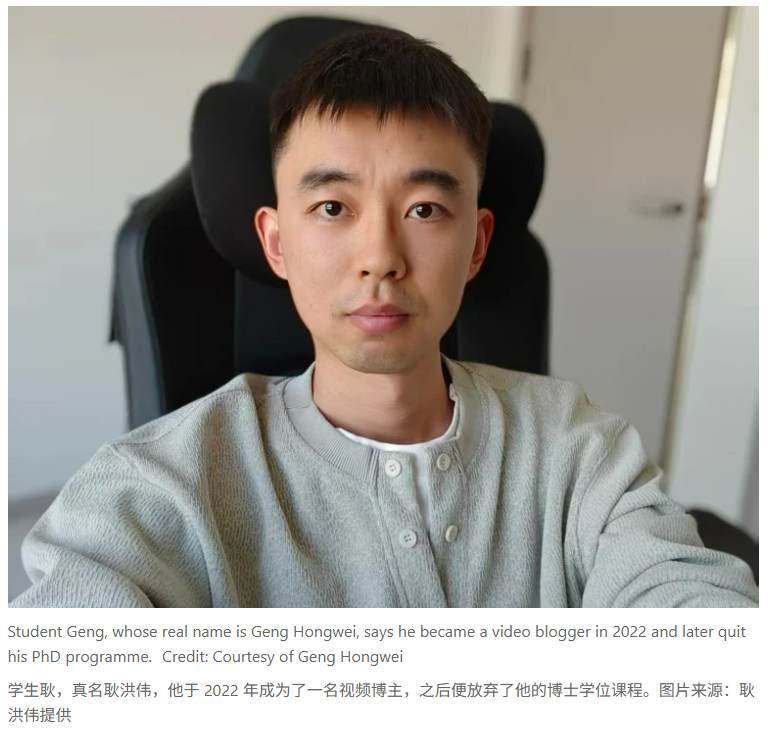
Geng says he hopes that his videos can show Chinese officials that academic misconduct in the country is a serious issue that must be dealt with.
耿表示,他希望自己的视频能够向中国官员表明,学术不端行为在这个国家是一个必须被严肃处理的问题。
But Geng’s actions have also drawn criticism. “Some students worry that his combating academic misconduct may result in one or two high-profile researchers being penalized, but, ultimately, the responsibility and workload will land on normal students if there is a crackdown on papers,” says Jiang Rui, a master’s student of materials science and engineering in Hefei, China.
不过,耿的行为也引发了批评。“一些学生担心,他打击学术不端行为的行为可能会导致一两位知名研究人员受到处罚。但实际上,如果进行论文审查的话,责任和工作量都将落在普通学生身上,”中国合肥的材料科学与工程专业硕士学生江瑞说道。
One concerned viewer left a comment on Geng’s videos, saying: “I just want to graduate smoothly so I can find a job ... The more accusations emerged, the more likely universities will increase their supervision over papers. Those affected the most will be students.”
一位关心的观众在耿的视频评论区留言说:“我只想顺利毕业,这样就能找到工作……随着越来越多的指控出现,大学对论文的审查力度可能会越来越大。最受影响的将是那些学生。”
Jiang says he, his colleagues and friends have discussed Geng’s viral videos, and opinions are divided. “But the fact that he is a PhD dropout, not an established researcher, makes him and his action more relatable to us,” Jiang says.
江表示,他、他的同事以及朋友们都讨论过耿的那些视频,大家的看法各不相同。“不过,由于耿只是个博士毕业的失败者,而不是什么知名学者,所以他和他的行为让我们觉得更有共鸣,”江说道。
Deeper issues 更深层的问题
Geng’s virality has laid bare some challenges facing China’s academic system, say interviewees. One such problem is the quality of some research publications, they say.
受访者表示,耿的网红效应揭示了中国学术体系面临的一些挑战。他们指出,其中一个问题是部分研究论文的质量问题。
“One can be very impressed by the rapid progress of Chinese science, which has risen from very little even 26 years ago,” says Rao Yi, a neurologist at Peking University in Beijing and a high-profile critic of academic misconduct in the country. But Rao adds he’s also “saddened by both the number and the ratio of papers containing fabrications from China”.
“中国科学的快速发展令人印象深刻,26 年前中国的科学水平几乎一文不值,”北京大学的神经学家饶毅如此说道。他同时也是中国学术不端行为批评界的知名人士。不过,饶毅也指出,他同时对那些包含来自中国的虚假内容的论文数量以及比例感到遗憾。
As the number of papers published by China-based authors has grown rapidly, so has their number of retractions. As of 2023, more than half of the 50,002 publications that had been retracted around the world involved at least one Chinese research institution — more than five times the number from the United States, according to an analysis by Xu and his colleague7. About 20% of the retractions from Chinese researchers were caused by the use of paper mills, businesses that churn out fraudulent or poor-quality manuscripts on demand; plagiarism accounted for 4.3%, and fabrication or falsification made up 2.8%, according to the analysis. (Retractions are often used as a proxy for measuring scientific misconduct in the absence of an alternative metric, which has itself caused controversy: some publishers argue that retractions often demonstrate a commitment to responsible practices.)
随着中国学者发表的论文数量迅速增加,相关论文被撤回的情况也越来越多。截至 2023 年,全球范围内被撤回的 50,002 篇论文中,有超过一半的论文涉及中国研究机构。这一比例是美国的一半以上。根据 Xu 和他的同事的分析,大约 20%的中国学者论文被撤回的原因在于使用了那些专门撰写虚假或质量低下的论文的公司。分析还显示,抄袭行为占到了 4.3%,而捏造或伪造论文则占到了 2.8%。(在没有其他衡量标准的情况下,撤回论文常被用作衡量科学不端行为的手段,但这本身也引发了争议:一些出版商认为,撤回论文实际上体现了他们对负责任行为的承诺。)
Science misconduct happens all around the world, but China is “very prone to” it because of the high volume of papers its researchers publish, “so the absolute number is going to be high”, Bik says.
科学领域的不当行为在全球各地都存在,但由于中国的研究人员发表的论文数量巨大,因此中国在这方面的问题尤为严重。“所以,出现不当行为的情况会比较多,”Bik 说道。
State-media outlets and some researchers interviewed by Nature also point to the urgency of improving China’s academic-evaluation system, which typically prioritizes quantity-based metrics, particularly how many papers an individual or university has published in high-impact journals. The system has been criticized in the past over its negative effect on research integrity by putting quantity ahead of quality, says Johannes Knops, a retired ecologist at the University of Nebraska–Lincoln who has worked in China and tracked academic misconduct for the past six years.
《自然》杂志采访的媒体机构和一些研究人员也指出,改善中国的学术评价体系至关重要。目前的评价体系往往以数量指标为主,尤其是个人或大学在高质量期刊上发表的论文数量。内布拉斯加大学林肯分校的退休生态学家约翰内斯·克诺普斯表示,过去一直有人批评这种评价体系,因为它将数量置于质量之上,从而影响了研究的诚信性。克诺普斯在中国工作过六年,期间一直负责监督学术不端行为。
China has been trying to move away from the system through a major evaluation reform launched in 2020. But several high-profile cases of misconduct in the past few years show that “there are still people who want to strike quick success in the academic circle and the normal supervision channels are somewhat blocked”, Tian Chenxu, a columnist at Banyuetan, a publication affiliated with Xinhua News, wrote in a commentary about Geng on 21 May.
中国一直在努力摆脱这种制度,于 2020 年启动了一项重大的评估改革。然而,过去几年中出现的几起严重的不当行为事件表明,“仍然有人希望在学术界迅速取得成功,而正常的监督渠道因此受到了一定程度的阻碍。”新华社旗下刊物《文汇报》的评论员田晨旭在 5 月 21 日关于耿的评论文章中这样写道。
Although the Chinese government has banned universities from using the number of publications as the only way to assess faculty performance, in reality, the metric is still “deeply bound” to the ranking of departments and staff promotion, Tian wrote.
虽然中国政府已经禁止大学仅以出版论文数量作为评估教师绩效的标准,但实际上,这一指标仍然与院系排名以及教师的晋升密切相关,田写道。
Geng says that his plan now is to shine a light on researchers who spend time and effort doing rigourous research, rather than rushing out papers.
耿表示,他现在的计划是给那些花费时间和精力做严谨研究的研究者们点亮一盏明灯,而不是匆忙发表论文。
“I want to find some real-life examples of them to show that even though they publish less papers than their peers, they can also receive recognition for their work,” he says.
“我希望找到一些现实中的例子来证明,尽管他们发表的论文数量比同行少,但他们仍然能够因其工作而获得认可,”他说。
来源:蔚青学者,爱科会易仅用于学术交流,若相关内容侵权,请联系删除。