
 国际站
国际站 
一、Rebuttal是什么?为什么如此关键?
1.1 定义
Rebuttal(作者反驳/回复)是学术会议审稿流程中,作者针对审稿人意见进行正式回应的环节。通常在收到审稿意见后,会议给予作者5-14天的窗口期提交书面回复。
1.2 Rebuttal的战略意义
| 维度 | 说明 |
|---|---|
| 直接影响最终决定 | Area Chair会参考Rebuttal做最终裁定 |
| 可以纠正审稿人的误解 | 审稿人可能误读了你的论文 |
| 可以补充缺失信息 | 展示额外实验结果或解释 |
| 展示作者的学术态度 | 专业、谦逊、有理有据的回复加分 |
| 翻盘概率可观 | 据估计,好的Rebuttal可将Borderline论文录用率提升20-40% |
1.3 哪些会议有Rebuttal环节
| 有Rebuttal | 无Rebuttal |
|---|---|
| CVPR, ICCV, ECCV | 部分B/C类小型会议 |
| NeurIPS, ICML, ICLR | 部分快速审稿会议 |
| ACL, EMNLP, NAACL | ICDM(部分年份无) |
| AAAI, IJCAI | 部分通信类会议(ICC/GLOBECOM) |
| KDD, SIGIR, WWW | -- |
| CHI, UIST | -- |
二、Rebuttal的核心原则
2.1 六大黄金原则
| 原则 | 说明 |
|---|---|
| 逐条回复 | 不遗漏任何一条意见,证明你认真阅读了 |
| 先感谢后回答 | 保持尊重和专业,即使意见不合理 |
| 用事实说话 | 数据、实验结果、引用文献比辩论更有力 |
| 承认合理批评 | 对正确指出的问题坦诚承认并说明改进方案 |
| 简洁有力 | 字数有限,每句话都要有信息量 |
| 优先级明确 | 先解决最关键的质疑,再处理次要问题 |
2.2 Rebuttal不是什么
| 错误认知 | 正确认知 |
|---|---|
| 与审稿人争论/吵架 | 是专业的学术沟通 |
| 情绪化的辩护 | 是冷静客观的回应 |
| 否定所有批评 | 是有选择地承认和反驳 |
| 重新讲述论文全部内容 | 是针对性回答具体质疑 |
| 承诺"我会在终稿中修改" | 是展示已有的证据和结果 |
三、Rebuttal整体结构框架
3.1 推荐结构
[开头:总体感谢 + 全局回应(可选)]

We thank all reviewers for their constructive comments.
We address each concern below.

[针对每位审稿人逐条回复]

## Reviewer 1 (R1)

**R1-Q1: [审稿人的具体问题/意见]**
[你的回复]

**R1-Q2: [审稿人的具体问题/意见]**
[你的回复]

...

## Reviewer 2 (R2)
...

## Reviewer 3 (R3)
...

[结尾(可选):总结关键改进承诺]
3.2 篇幅控制
| 会议 | Rebuttal字数/页数限制 | 建议 |
|---|---|---|
| CVPR/ICCV/ECCV | 通常无严格限制 | 建议控制在1-2页 |
| NeurIPS | 不超过一定字符数 | 严格遵守限制 |
| ICML | 有字数限制 | 精简为主 |
| ICLR | OpenReview讨论无硬性限制 | 每条回复简洁,但可多轮互动 |
| ACL/EMNLP | 有页数限制(通常1页) | 极度精简 |
| AAAI | 有字数限制 | 优先回应关键问题 |
3.3 格式技巧
| 技巧 | 说明 |
|---|---|
| 审稿人原文用粗体/斜体引用 | 让读者(AC)清楚对应关系 |
| 用标号区分不同问题 | R1-Q1, R1-Q2便于索引 |
| 关键数据加粗 | 重要的实验数字突出显示 |
| 新增实验结果用表格呈现 | 比纯文字更清晰 |
| 不同审稿人分section | 结构清晰 |
四、万能回复模板:按意见类型分类
4.1 技术质疑类
审稿人说方法有缺陷/技术问题:
模板:
**R1-Q1: "The proposed method does not account for [specific issue],
which could lead to [potential problem]."**

We appreciate this insightful observation. We would like to clarify
that our method does handle this case through [specific mechanism
described in Section X, Line Y]. Specifically, [brief technical
explanation].

To further validate this, we conducted an additional experiment
under the condition described by the reviewer:

| Setting | Baseline | Ours |
|---------|----------|------|
| [condition] | XX.X% | YY.Y% |

These results confirm that our method remains robust under [the
questioned scenario].
如果审稿人确实指出了真正的问题:
**R1-Q2: "The loss function in Eq. (3) may not converge when [condition]."**

We thank the reviewer for identifying this issue. The reviewer is
correct that under [specific condition], convergence is not
guaranteed. We have addressed this by:
1. Adding a regularization term (lambda=0.01) that ensures stability
2. Conducting convergence analysis (results below)

[补充实验或分析结果]

We will incorporate this fix and the corresponding analysis in
the final version.
4.2 实验不充分类
审稿人要求更多实验/对比/数据集:
**R2-Q1: "The experiments are conducted on only two datasets.
Results on [Dataset X] would strengthen the paper."**

We agree that additional datasets would strengthen our evaluation.
We have now conducted experiments on [Dataset X] as suggested:

| Method | Dataset A | Dataset B | Dataset X (NEW) |
|--------|-----------|-----------|-----------------|
| Baseline 1 | XX.X | XX.X | XX.X |
| Baseline 2 | XX.X | XX.X | XX.X |
| Ours | **YY.Y** | **YY.Y** | **YY.Y** |

Our method consistently outperforms baselines on the new dataset,
confirming the generalizability of our approach.
审稿人要求对比特定Baseline:
**R2-Q2: "The paper does not compare with [Method Z] (CVPR 2025),
which is a strong recent baseline."**

Thank you for pointing out this relevant work. We have now
included [Method Z] in our comparison:

| Method | Metric 1 | Metric 2 |
|--------|----------|----------|
| Method Z (CVPR'25) | XX.X | XX.X |
| Ours | **YY.Y** | **YY.Y** |

Our method outperforms [Method Z] by [+X.X points] on [Metric],
primarily because [brief explanation of advantage].
审稿人要求消融实验:
**R3-Q1: "An ablation study is needed to demonstrate the
contribution of each component."**

We appreciate this suggestion. Below is the ablation study:

| Configuration | Accuracy | F1 |
|--------------|----------|-----|
| Full model (Ours) | **92.3** | **89.7** |
| w/o Module A | 89.1 (-3.2) | 86.5 |
| w/o Module B | 90.5 (-1.8) | 87.9 |
| w/o Module C | 88.7 (-3.6) | 85.2 |

Each component contributes meaningfully: Module C provides the
largest improvement (+3.6%), followed by Module A (+3.2%).
This will be included in the final version.
4.3 新颖性/贡献质疑类
审稿人说"incremental"或创新不足:
**R1-Q3: "The contribution seems incremental over [Prior Work X].
The differences are not sufficiently justified."**

We respectfully disagree that our contribution is incremental.
While [Prior Work X] addresses [problem A] using [approach A],
our work fundamentally differs in the following ways:

1. **Problem formulation**: We formulate [new problem B] which
   [Prior Work X] does not address. Specifically, [explanation].

2. **Technical novelty**: Our [specific module/theory] is entirely
   new — [Prior Work X] uses [their approach], while we propose
   [our approach] which enables [unique capability].

3. **Empirical gap**: Our method outperforms [Prior Work X] by
   [+X.X%] on [benchmark], demonstrating clear practical value.

We will further clarify these distinctions in the revised Introduction.
审稿人说与某篇论文太相似:
**R2-Q3: "This work is very similar to [Paper Y]. The authors
should clearly articulate the differences."**

Thank you for raising this comparison. While both our work and
[Paper Y] address [general topic], the key differences are:

| Aspect | Paper Y | Ours |
|--------|---------|------|
| Problem | [their problem] | [our different problem] |
| Method | [their approach] | [our different approach] |
| Data | [their data] | [our different data] |
| Key insight | [their insight] | [our different insight] |

Furthermore, [Paper Y] cannot handle [specific scenario] that
our method addresses, as demonstrated in Table X of our paper.
4.4 写作清晰度类
审稿人说论文难以理解:
**R3-Q2: "Section 3.2 is hard to follow. The notation is
inconsistent and the motivation for [design choice] is unclear."**

We apologize for the confusion and thank the reviewer for
identifying this issue. We will revise Section 3.2 to:

1. Unify notation throughout (using [x] consistently for [meaning])
2. Add a paragraph at the beginning of 3.2 explicitly motivating
   [design choice]: the key reason is [brief explanation]
3. Include Figure X (a schematic diagram) to illustrate the pipeline

To clarify the motivation here: we chose [approach] because
[concise 2-3 sentence explanation that should have been in the paper].
4.5 缺少相关工作引用类
**R1-Q4: "Several relevant works are missing from the related
work section: [Paper A], [Paper B], [Paper C]."**

Thank you for these pointers. We will add discussion of these
works in the revised version:

- [Paper A]: addresses [X]; differs from ours in [aspect].
  Our method handles [Y] which [Paper A] does not.
- [Paper B]: proposes [Z]; we extend this idea by [extension].
- [Paper C]: relevant as a baseline; we now include experimental
  comparison (see R2-Q2 above).
4.6 审稿人明显误读论文
审稿人理解错了你的方法/结果:
**R2-Q4: "The method requires access to [X] at test time,
which is an unrealistic assumption."**

We appreciate the chance to clarify. Our method does NOT require
[X] at test time. As stated in Section 3.1 (Line 15-17): "[exact
quote from paper]". [X] is only used during training to [purpose].
At inference time, our model only needs [Y] as input.

We acknowledge that this point may not have been sufficiently
clear, and we will add an explicit "Inference Procedure" paragraph
in the revised version to prevent this confusion.
关键技巧: 指出审稿人误读时,永远不要用攻击性语言(如"The reviewer is wrong"或"The reviewer clearly did not read our paper")。用"We would like to clarify..."或"We appreciate the chance to clarify..."。
五、高级策略:最大化Rebuttal效果
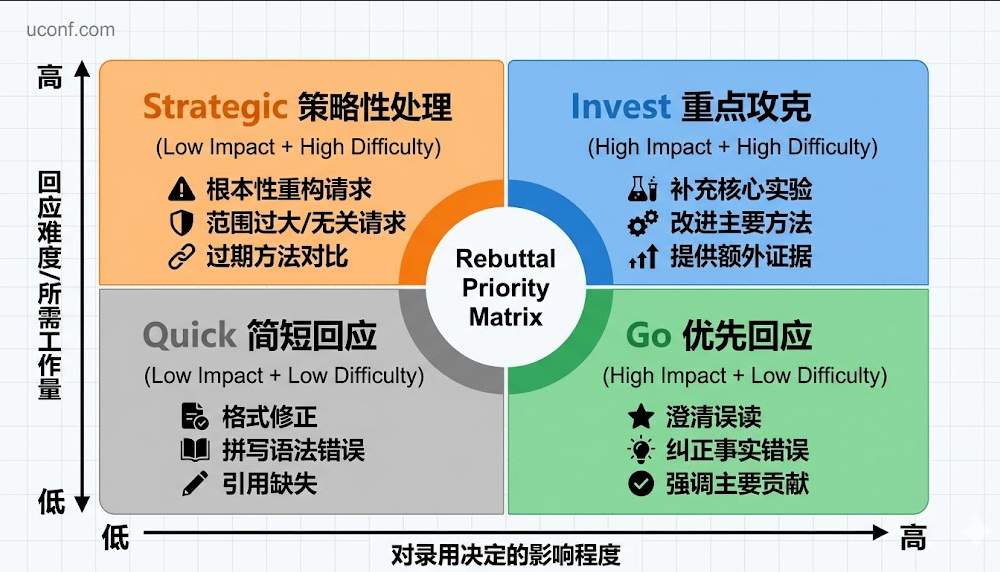
5.1 策略一:优先解决"可翻盘"的问题
Rebuttal篇幅有限,需要判断哪些问题值得重点回答:
| 优先级 | 问题类型 | 理由 |
|---|---|---|
| 最高 | 基于误读的质疑 | 澄清即可翻盘 |
| 最高 | 可以用新实验数据回答的 | 直接展示结果最有说服力 |
| 高 | 多位审稿人共同提出的 | AC会特别关注共性质疑 |
| 中 | 写作清晰度问题 | 承认+展示修改方案 |
| 低 | 无法在短期内解决的根本性问题 | 只能承认局限性 |
5.2 策略二:用数据说话,不用辩论说话
对比示例:
弱回复:
"We believe our method is novel because it uses a different
architecture from previous work."
强回复:
"Our method achieves 94.2% accuracy vs. 89.7% of [Prior Work],
a +4.5% improvement. The key architectural difference — [specific
module] — accounts for +3.8% of this gain (see ablation in R3-Q1)."
5.3 策略三:在Rebuttal期间跑新实验
| 做法 | 说明 |
|---|---|
| 审稿意见发放前就准备 | 预判可能的质疑,提前跑备用实验 |
| 收到意见后立即开跑 | Rebuttal窗口通常5-14天,时间紧迫 |
| 优先跑"最能说服审稿人"的实验 | 如新数据集、新Baseline对比 |
| 结果即使不完美也要展示 | 展示努力和额外工作量 |
5.4 策略四:利用"Common Response"回应共性问题
当多位审稿人提出相同质疑时,可以在Rebuttal开头统一回应:
## Common Response to All Reviewers

**Regarding the scalability concern raised by R1, R2, and R3:**

We have conducted additional scalability experiments:

| Input Size | Runtime (Ours) | Runtime (Baseline) |
|-----------|----------------|-------------------|
| 1K | 0.3s | 0.5s |
| 10K | 2.1s | 4.8s |
| 100K | 18.5s | 52.3s |

Our method scales linearly (O(n)) while the baseline scales
quadratically (O(n^2)), confirming practical scalability.
5.5 策略五:引导AC的Meta-review
Area Chair在做最终决定时会阅读Rebuttal。可以在结尾或开头简要总结:
**Summary of key responses:**
- R1's main concern (scalability): Resolved with new experiments
  showing linear scaling.
- R2's main concern (missing baseline): New comparison with
  [Method Z] shows +4.5% improvement.
- R3's main concern (unclear writing): Acknowledged; revision
  plan provided.

We believe these responses address the major concerns, and the
paper's core contributions — [1-sentence summary] — remain strong.
六、不同评分情况的Rebuttal策略
6.1 全面正面(高分,接近Accept)
| 策略 | 说明 |
|---|---|
| 简短回复即可 | 不需要长篇回应 |
| 对小建议表示感谢 | "Thank you, we will incorporate this in the final version." |
| 不要画蛇添足 | 回复过长反而可能引发新质疑 |
| 巩固优势 | 简要强调审稿人认可的亮点 |
6.2 分歧严重(有高分也有低分)
| 策略 | 说明 |
|---|---|
| 重点回应低分审稿人 | 争取让其改变评分 |
| 借助高分审稿人的评价 | "As noted by R1 and R3, our key contribution is..." |
| 如果低分基于误读 | 清晰澄清,AC会看到 |
| 如果低分审稿人明显不专业 | 客观指出事实错误,让AC判断 |
6.3 全面负面(低分,Strong Reject)
| 策略 | 说明 |
|---|---|
| 仍然要认真回复 | AC会看Rebuttal做最终判断 |
| 承认问题但强调贡献 | "While we acknowledge [limitation], our contribution of [X] is..." |
| 展示额外工作 | 新实验结果可能改变评分 |
| 管理期望 | 全面负面翻盘概率<10%,但不是0 |
| 为改投做准备 | Rebuttal中的回应可指导后续修改方向 |
七、Rebuttal中的语言技巧
7.1 高频开头句式
| 场景 | 句式 |
|---|---|
| 感谢审稿人 | "We thank Reviewer X for this constructive feedback." |
| 澄清误解 | "We would like to clarify that..." |
| 同意审稿人 | "The reviewer raises a valid point. We agree that..." |
| 礼貌反驳 | "We respectfully disagree with this assessment because..." |
| 提供新证据 | "To address this concern, we conducted additional experiments..." |
| 承诺修改 | "We will revise [Section X] in the final version to..." |
7.2 高频过渡/连接句式
| 场景 | 句式 |
|---|---|
| 引出数据 | "Specifically, the results show that..." |
| 对比说明 | "In contrast to [Prior Work], our approach..." |
| 强调区别 | "The key difference lies in..." |
| 补充说明 | "Furthermore, we note that..." |
| 引用论文 | "As stated in Section X (Line Y): '[quote]'" |
| 总结回应 | "In summary, [concern] is addressed by [solution]." |
7.3 应该避免的表达
| 避免 | 为什么 | 替代 |
|---|---|---|
| "The reviewer is wrong." | 攻击性 | "We would like to clarify..." |
| "We disagree." (无解释) | 空洞 | "We respectfully hold a different view because [evidence]." |
| "Obviously..." / "Clearly..." | 暗示审稿人无知 | "As shown in [evidence]..." |
| "The reviewer did not read carefully." | 冒犯性 | "We may not have stated this clearly enough; as noted in Section X..." |
| "We will fix this later." (无具体方案) | 空洞承诺 | "Specifically, we will [concrete action] in [specific section]." |
| "This is beyond the scope." (拒绝回答) | 回避感 | "While [X] is an interesting direction, our current scope focuses on [Y] because [reason]. We will note this as future work." |
7.4 承认问题的专业表达
| 表达 | 适用场景 |
|---|---|
| "The reviewer raises a valid concern." | 确实是一个问题 |
| "We acknowledge this as a limitation of our current work." | 无法在短期内解决 |
| "This is an excellent suggestion that we will incorporate." | 建设性意见 |
| "We agree that additional experiments would strengthen the paper." | 实验不充分的批评 |
| "We thank the reviewer for identifying this oversight." | 确实遗漏了 |
八、完整Rebuttal范例
以下是一篇模拟的完整Rebuttal,展示标准格式和语言风格:
We sincerely thank all reviewers for their time and constructive
comments. Below we address each concern point by point.

================================================================
## Response to Reviewer 1 (Score: 6/10)
================================================================

**R1-Q1: "The comparison with [Method X, CVPR'25] is missing.
This is a strong recent baseline that should be included."**

Thank you for this suggestion. We have conducted the comparison:

| Method | CIFAR-100 | ImageNet | Avg |
|--------|-----------|----------|-----|
| Method X (CVPR'25) | 82.1 | 76.4 | 79.3 |
| Ours | **84.7** | **78.9** | **81.8** |

Our method outperforms Method X by +2.5% on average. The gain
comes primarily from our [specific module], which explicitly
models [specific aspect] that Method X overlooks.

**R1-Q2: "Why does the method perform worse on Dataset C
(Table 3, row 5)?"**

Good observation. The lower performance on Dataset C is due to
its unique characteristic of [specific property]. We analyzed
this case and found that when [condition], our approach defaults
to [behavior], which is suboptimal for [reason].

We have added a simple adaptation (adjusting hyperparameter
alpha from 0.5 to 0.3 for such cases) that improves results:
- Before adaptation: 71.2%
- After adaptation: 75.8% (+4.6%)

This will be discussed in the final version.

================================================================
## Response to Reviewer 2 (Score: 5/10)
================================================================

**R2-Q1: "The novelty is limited. The proposed [module] is
essentially [existing technique] with minor modifications."**

We respectfully disagree with this characterization. While our
[module] shares the high-level intuition of [existing technique],
the technical realization is fundamentally different:

1. [Existing technique] operates on [representation A]; ours
   operates on [representation B], enabling [unique capability].
2. We introduce [specific innovation] which has no counterpart
   in [existing technique].
3. The theoretical justification (Theorem 1) is entirely new and
   provides [specific guarantee] that [existing technique] lacks.

The empirical gap (+4.5% over [existing technique] in Table 2)
further confirms that these are not "minor modifications."

**R2-Q2: "The paper does not include an ablation study."**

We have now completed a comprehensive ablation:

| Configuration | Acc. | F1 |
|--------------|------|-----|
| Full model | **92.3** | **89.7** |
| w/o Component A | 89.1 | 86.5 |
| w/o Component B | 90.5 | 87.9 |
| w/o Both A & B | 86.3 | 83.1 |

Each component contributes significantly, and their combination
is synergistic (joint removal: -6.0% vs. sum of individual
removals: -4.9%).

================================================================
## Response to Reviewer 3 (Score: 7/10)
================================================================

**R3-Q1: "Minor: Some typos and grammatical issues throughout."**

Thank you. We will carefully proofread the final version.

**R3-Q2: "It would be nice to include a visualization of
the learned representations."**

Great suggestion. We have generated t-SNE visualizations of
the learned features (available upon request / will be included
in the final version). The visualization clearly shows [key
observation], confirming that our method learns [desired property].

================================================================
## Summary
================================================================

We believe the major concerns have been addressed:
- Missing baseline (R1): New comparison shows +2.5% over Method X
- Novelty (R2): Clarified fundamental differences from prior work
- Ablation (R2): Comprehensive study demonstrating each component
- Dataset C issue (R1): Identified cause and provided solution

We are committed to incorporating all feedback in the final version.
九、ICLR OpenReview的特殊Rebuttal策略
ICLR采用OpenReview平台,Rebuttal机制与传统会议不同:
9.1 OpenReview特点
| 特点 | 影响 |
|---|---|
| 审稿意见公开 | 所有人可见(包括其他审稿人) |
| 可多轮互动 | 不限于一次回复,可持续讨论 |
| Discussion Period较长 | 通常4-6周 |
| 审稿人可修改评分 | Rebuttal后审稿人可以调整分数 |
| 公众可以评论 | 外部学者的正面评论可能帮助 |
9.2 OpenReview策略
| 策略 | 说明 |
|---|---|
| 快速回复 | 不要等到最后一天,尽早回应让讨论充分 |
| 关注审稿人的后续问题 | 可能追问,需持续关注 |
| 每条回复独立且完整 | 因为是线程式讨论 |
| 礼貌但坚定 | 公开可见,语气更需专业 |
| 利用审稿人之间的互动 | 如果R1的评价支持你,可以引用 |
十、Rebuttal提交前检查清单
| 检查项 | 说明 |
|---|---|
| 是否逐条回应了每位审稿人的每个问题 | 不遗漏 |
| 是否在字数/页数限制内 | 超限可能不被接受 |
| 新增实验数据是否准确 | 反复核验数字 |
| 引用论文原文的行号/页码是否正确 | 避免指错位置 |
| 语气是否全程专业尊重 | 没有攻击性表述 |
| 是否有拼写/语法错误 | 影响专业形象 |
| 格式是否清晰可读 | AC需要快速阅读 |
| 是否让合作者/导师审阅过 | 第二双眼睛避免遗漏 |
| 是否在截止时间前提交 | 提前数小时避免系统问题 |
十一、Rebuttal之后:等待与后续
11.1 Rebuttal提交后可能发生什么
| 后续环节 | 说明 |
|---|---|
| 审稿人讨论(Discussion) | 审稿人之间基于你的回复进行讨论 |
| 审稿人可能调整评分 | 好的Rebuttal可促使加分 |
| AC撰写Meta-review | 综合审稿意见和Rebuttal做判断 |
| AC可能联系作者(少见) | 要求进一步澄清(好信号) |
| 最终决定 | Accept / Reject |
11.2 审稿人调整评分的概率
| 情况 | 评分调整概率 | 说明 |
|---|---|---|
| Rebuttal提供了令人信服的新实验 | 约30-40% | 最可能促成改分 |
| Rebuttal澄清了明确的误读 | 约40-50% | 审稿人通常会修正 |
| Rebuttal仅承诺修改无新证据 | 约5-10% | 几乎不促成改分 |
| Rebuttal态度不好/有攻击性 | 可能降分 | 适得其反 |
11.3 如果最终仍被拒稿
即使Rebuttal写得很好仍被拒:
- Rebuttal中的回应指明了下一次投稿的改进方向
- 新增的实验数据可直接用于下一版论文
- 针对审稿人质疑准备的解释可以直接写入下一版正文中
- 将Rebuttal中"承诺的修改"全部落实到论文中再改投
核心思路: 把Rebuttal视为"下一版论文的修改指南"。即使本轮未能翻盘,这些工作不会浪费。
十二、高频错误:Rebuttal失败的常见原因
12.1 致命错误
| 错误 | 为什么致命 | 正确做法 |
|---|---|---|
| 攻击审稿人 | AC会站在审稿人一边 | 永远保持尊重 |
| 忽略某条意见不回复 | AC会认为你无法回应 | 逐条回复,即使简短 |
| 提供虚假实验数据 | 一旦被发现后果极其严重 | 只展示真实可验证的结果 |
| 超出字数/页数限制 | 可能被截断或不被接受 | 严格遵守限制 |
| 逾期提交 | 系统关闭后无法补交 | 提前至少数小时提交 |
12.2 常见低效做法
| 做法 | 为什么无效 | 改进 |
|---|---|---|
| 大段重复论文原文 | AC已经读过论文 | 简要指出位置即可 |
| 只说"will fix in final version" | 无法证明你有能力修好 | 展示具体修改方案或已有新结果 |
| 长篇辩论但无新证据 | 文字游戏说服不了人 | 用数据/实验/引用说话 |
| 回复所有问题篇幅一样 | 关键问题回答不够深入 | 重点问题详细回答,小问题简短 |
| 语气过度卑微 | 反而显得论文没有价值 | 自信而尊重 |
| 引入论文中没有的全新方法 | 审稿人无法验证 | 只展示与当前方法一致的补充实验 |
12.3 时间管理错误
| 错误 | 后果 | 预防 |
|---|---|---|
| 收到意见后拖延数天才开始 | 来不及跑新实验 | 当天开始分析意见 |
| 把所有时间花在写文字上 | 没有新数据支撑 | 优先跑实验,再写回复 |
| 最后一小时才提交 | 网络问题/系统崩溃 | 提前3-6小时完成 |
| 一个人闷头写 | 遗漏重要问题 | 让合作者审阅后再提交 |
十三、Rebuttal准备的时间规划
假设Rebuttal窗口为7天(常见于CVPR/NeurIPS等):
| 天数 | 工作 | 说明 |
|---|---|---|
| Day 1 | 仔细阅读所有审稿意见 | 不急于动手,先全面理解 |
| Day 1 | 与合作者讨论,制定回复策略 | 确定哪些可以跑实验回应 |
| Day 1-2 | 开始跑补充实验 | 越早开始越好 |
| Day 2-4 | 撰写Rebuttal初稿 | 先写能确定的部分 |
| Day 4-5 | 补充实验结果到回复中 | 整理数据、制作表格 |
| Day 5-6 | 内部审阅+修改 | 导师/合作者审阅 |
| Day 6 | 最终润色+格式检查 | 确保字数合规、无错误 |
| Day 7(截止前6小时) | 提交 | 留出缓冲时间 |
如果窗口只有5天:
| 天数 | 工作 |
|---|---|
| Day 1 | 分析意见 + 立即开跑关键实验 |
| Day 2-3 | 边跑实验边写回复 |
| Day 4 | 整合结果 + 内部审阅 |
| Day 5(截止前6小时) | 最终确认 + 提交 |
十四、投稿前的"预防性Rebuttal"准备
最好的Rebuttal策略是在投稿前就做好准备:
14.1 投稿前的自我审查
在提交论文前,假装自己是审稿人,问自己:
| 审稿人可能问的问题 | 你的准备 |
|---|---|
| "为什么不跟[Method X]比?" | 提前跑好对比,备用 |
| "在[Dataset Y]上效果如何?" | 提前跑好,备用 |
| "消融实验呢?" | 提前做好,至少准备数据 |
| "这跟[Prior Work]有什么区别?" | 提前准备对比表格 |
| "为什么选这个Loss/架构?" | 提前想好justification |
| "计算量/运行时间如何?" | 提前统计好数字 |
14.2 "备用实验仓库"策略
投稿前准备一批"备用实验"但不放入论文:
- 额外的数据集实验结果
- 额外的Baseline对比
- 详细的消融实验
- 运行时间/内存消耗统计
- 更多的可视化结果
这些实验在收到审稿意见后可以直接使用,无需重新跑。
十五、总结
Rebuttal的核心逻辑:
你不是在"说服"审稿人你是对的,你是在"展示证据"让审稿人和AC自己得出"这篇论文应该被录用"的结论。
写好Rebuttal的五字诀:
| 字 | 含义 |
|---|---|
| 谢 | 感谢每位审稿人的时间和意见 |
| 应 | 逐条回应,不遗漏任何问题 |
| 据 | 用数据和实验说话,不靠辩论 |
| 认 | 对合理批评坦诚承认 |
| 简 | 简洁有力,不说废话 |
效果预期:
| Rebuttal质量 | 对Borderline论文的影响 |
|---|---|
| 优秀(新数据+清晰澄清+专业态度) | 录用概率提升30-40% |
| 良好(针对性回应+部分新证据) | 录用概率提升15-25% |
| 一般(仅文字解释,无新证据) | 录用概率提升5-10% |
| 差劣(态度不好/遗漏问题/空洞承诺) | 录用概率不变甚至下降 |
最终建议:
Rebuttal的准备从投稿前就开始——提前做好备用实验、预判审稿人可能的质疑、保持论文写作的清晰度。收到审稿意见后,把它当作"有明确方向的限时考试":冷静分析、制定策略、用证据作答、按时提交。